

Defining Extreme AI-driven Power Concentration
A conceptual framework for understanding extreme concentration of power risks

Dr Imogen Stead & Hamish Hobbs
There is growing concern (see also here and here) that advances in AI could enable unprecedented levels of power to be concentrated in the hands of very few, disempowering the majority of people. The recent dispute between Anthropic and the Department of War is a warning shot for how these risks will materialise in the future. AI will provide powerful new capabilities, and we need robust approaches to ensure that the way AI is developed and deployed upholds rather than undermines pluralist values and the political institutions we have designed to protect these values. In some cases, we believe that the potential harms from AI-driven concentration of power could reach the threshold of an extreme risk, resulting in enduring and severe global disempowerment of the majority of people. There are relatively few organisations currently working to assess and manage potential risks of AI-driven power concentration, making this issue both important and neglected.
AI-driven power concentration is a broad topic: there are many types of power and differing levels of AI-enabled concentration, not all of which necessarily represent extreme risks. This post seeks to define what constitutes an extreme AI-driven power concentration risk and how these scenarios could emerge. The framework set out below is intended to map out the most worrying pathways towards extreme AI-driven power concentration and to support further thinking on which interventions may be needed to mitigate these risks.
Defining extreme AI-driven power concentration
The concept of “power” is most often used to describe the ability to exert control, authority, or influence over others. We define power as:
The ability of an actor to secure outcomes it favours, including over the resistance of others.
This borrows from Weber’s definition of power as “the probability that one actor within a social relationship will be in a position to carry out his own will despite resistance”.
Power concentration can take many forms - such as political, economic, epistemic (meaning control over facts and knowledge), military, or technological - and manifest itself in ways that are already familiar to us today, such as authoritarian political regimes or economic monopolies. Repressive regimes and severe economic inequality already create widespread disempowerment, leading to severe harm and death.
As capabilities advance, AI could increase existing forms of power concentration or introduce new ones. We define extreme AI-driven power concentration as:
“A scenario where AI enables a single actor or small group of actors to acquire sufficient power (whether economic, political, military, and/or epistemic/ideological) to severely disempower a majority of people in a way that becomes structurally entrenched, creating a self-reinforcing order that cannot be meaningfully contested or reversed.”
The three major components of this definition can help us to think more clearly about different ways that extreme power concentration might arise:
AI needs to enable an actor to acquire power.
The actor needs to use the power to disempower a majority of persons.
This disempowerment needs to become structurally entrenched.
Some examples of how extreme power concentration risks could materialise are set out in the table below.
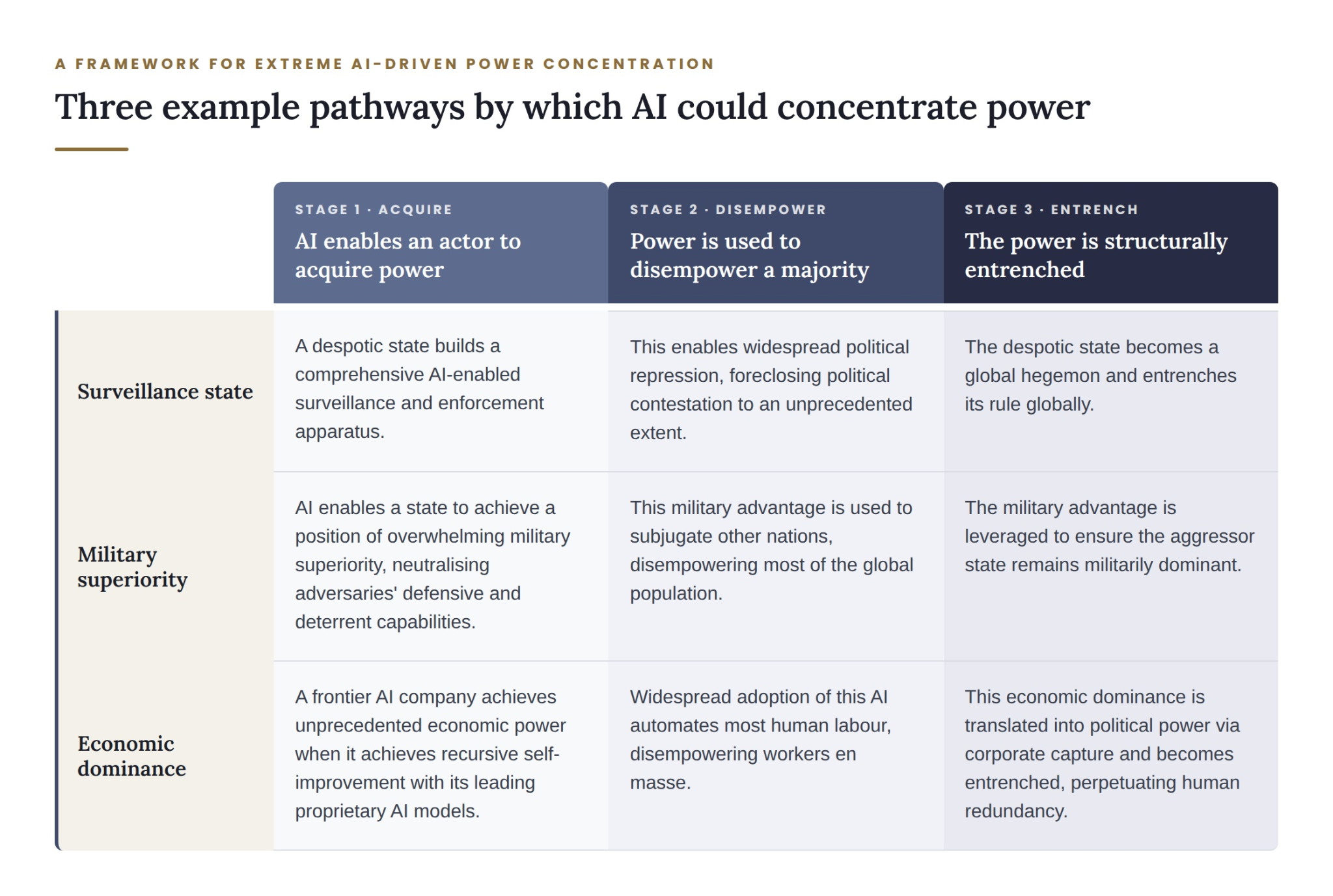
This three-component definition provides a coherent framework for assessing: (i) which scenarios fall within the scope of “extreme AI-driven power concentration risks”, (ii) which risks are the most important and urgent, and (iii) which interventions are best suited to preventing or mitigating these priority risks.
Below, we unpack the three components by considering some of the different ways they might emerge in practice. These sub-components are not necessarily mutually exclusive or exhaustive, but are intended to provide a good cross-section of the primary routes to the emergence of extreme AI-driven power concentration scenarios.
AI-enabled acquisition of power
This component describes how AI could disproportionately empower one or a few actors. Key mechanisms include:
Asymmetric software access: where uneven access to advanced AI models and systems means that only one or a few actors can access the most advanced capabilities. This could occur in various ways, including:
Gradually: If one country or lab incrementally gains a capability lead that is then reinforced over time, creating a structural advantage.
Rapidly: If an intelligence explosion occurs (e.g., via recursive self-improvement) in one lab or jurisdiction that suddenly creates or widens capability gaps.
Instantaneously: If AI systems are hacked, assigned specific loyalties, or their control is seized using policy, force or coercion.
Asymmetric hardware and infrastructure access: where uneven hardware access limits access to AI capabilities. AI systems require specific hardware and infrastructure to function, such as data centres with advanced AI chips. Key infrastructure is currently concentrated in a small number of companies and countries: for instance, in Q1 2026 the value of NVIDIA chips sold made up 83% of the total market for AI chips, Taiwan’s TSMC manufactures around 90% of the world’s most advanced semiconductors, and just three companies (Amazon, Microsoft, and Google) control over two-thirds of global AI compute capacity.
Asymmetric advantage from AI: where actors use a combination of AI access and other factors to gain asymmetric advantage from AI. This could include examples such as a government leveraging its security apparatus combined with AI to repress its citizens, AI providing an advantage to aggressors that lets them overcome defenders and seize power, or an AI developer making its AI systems widely available, but capturing almost all of the economic benefit and gaining a hegemonic economic position due to market structure.
Disempowerment of the majority
This component highlights that for AI-derived power to cause harm, it needs to actually be exercised in a way that disempowers others, such as via:
Political disempowerment: AI may enable the concentration of political power through coups, democratic backsliding, and corporate capture of governance bodies, as well as AI-enabled mass surveillance and targeted political repression. An actor with privileged access to AI systems embedded in government administration, law enforcement, and information infrastructure may exploit these capabilities to overwhelm the institutional checks and balances that normally constrain the abuse of political power.
Economic disempowerment: AI may radically concentrate economic power through large-scale displacement of labour income, the capture of economic value by a small number of AI developers, or through one country’s economy far outgrowing the rest of the world. An actor controlling indispensable AI infrastructure - such as compute, foundation models, or AI-mediated services on which governments, industries, and critical systems depend - may leverage this position to dictate terms, resist governance, and shape economic and political outcomes in ways that benefit only a narrow group.
Coercive and military disempowerment: AI could enable coercive control through automated surveillance and enforcement, or through achieving a decisive strategic advantage in AI-enabled military and intelligence capabilities sufficient to neutralise adversaries’ deterrent and defence capabilities, enabling geopolitical hegemony.
Epistemic and ideological disempowerment: Control over AI-mediated information flows may enable an actor to shape what populations know and believe through censorship, disinformation, manipulation, persuasion and algorithmic curation of information environments. Unequal access to AI-powered analysis and insight could tilt the balance of knowledge power. Together, these mechanisms can undermine the informed deliberation and public contestation that democratic governance depends on.
Structural entrenchment
This component describes how actors weaponising the concentrated power from AI can embed their power in ways that cannot easily be contested or overridden by others (often referred to as ‘lock-in’ risks). Mechanisms could include:
Unitary leadership: historically, heads of state have needed to rely upon a ruling coalition that includes military leadership, intelligence services and senior officials who could stage leadership challenges or coups. Company leaders have had to rely on similar coalitions, such as boards and senior executives. AI could weaken or displace the role of this ruling coalition, allowing a head of state or company leadership to use loyal AI systems to implement their will directly.
Human redundancy: historically, people have been able to leverage the value of their labour, their market power, their role in armed forces, and the need for their cooperation in governance to retain a stake in the structures they operate in. AI could potentially undermine each of these if labour, economic activity, the armed forces, and legal enforcement are increasingly automated.
Entrenched superiority: soft power and economic or military challenges from rival countries or companies has often triggered leadership changes, but a self-reinforcing AI capability lead could potentially undermine the potential for this sort of challenge.
Values lock-in: historically, leadership change has often resulted from a leader’s death or gradual changes in a society or individual’s value system. Values embedded in AI systems could become locked in, such that they persist without these dynamics.
Technological dependency: societies could become dependent on AI systems, either because advanced AI capabilities become essential to the functioning of a society or because alternatives disappear.
Why this matters
We believe that having a coherent theoretical framework for conceptualising extreme power concentration risks is an important first step towards understanding and assessing the risks, as well as addressing potential harms through both prevention and mitigation strategies. In particular, we think this framework can be used in three key ways:
Create a shared language and understanding across the policy ecosystem, from researchers to policymakers, to facilitate better understanding of this risk profile and the severity of the harms it could cause.
Assess the likelihood and severity of different risks by observing historical case studies, evidence of current trends, and considering potential impacts of AI.
Systematically identify priority intervention points by considering which mitigations are most likely to be effective at tackling the risk pathways within each of the three components.
Increase the salience of these risks, many of which we believe are currently under-explored in AI governance research and policymaking, so that more researchers are encouraged to work in this field, and more decision-makers are incentivised to consider these risks when creating and implementing policy.
We are at the beginning of our work in this area and are interested in discussing this framework, our next steps, and the wider field with researchers and policymakers who are working in or thinking about this field.
With thanks to Rose Hadshar, Ashwin Acharya, Dr Jess Whittlestone and Patrick Levermore, who provided helpful feedback on earlier versions of this work.